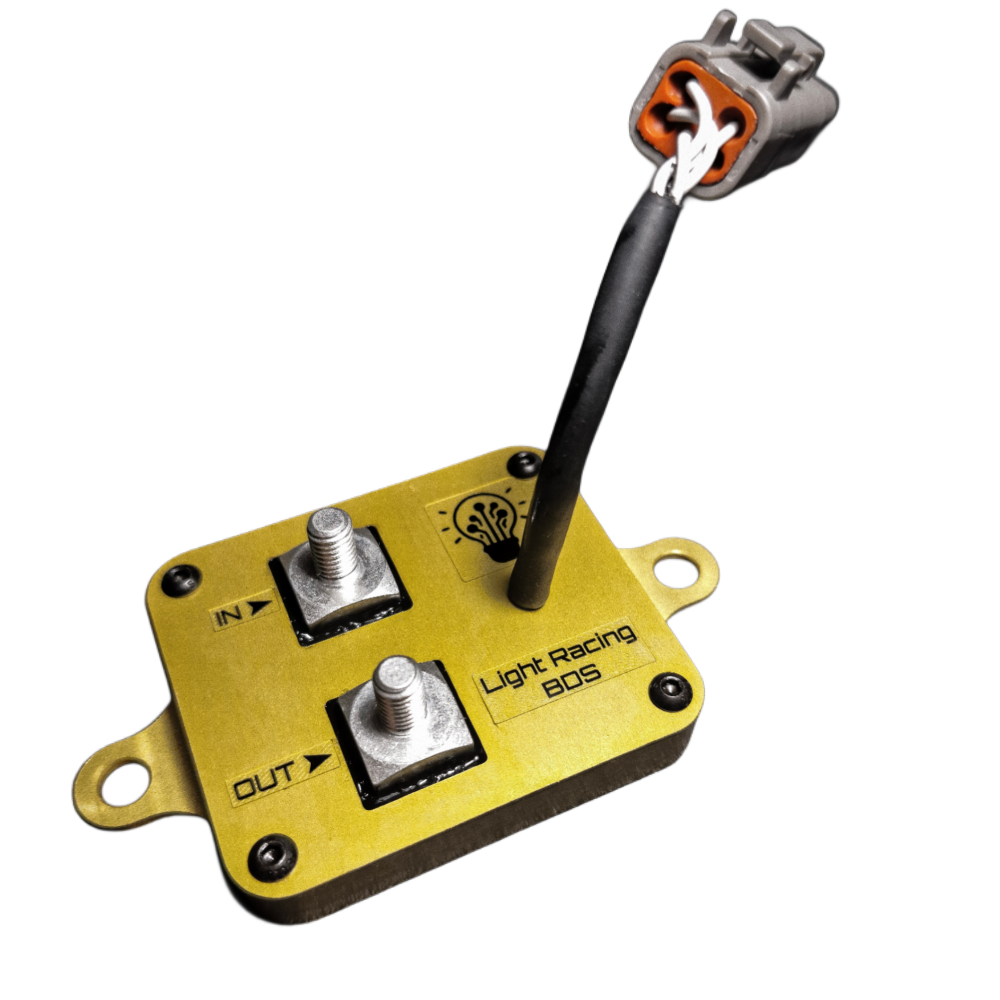
The Red Key Is Dead: Light Racing's Solid-State Battery Disconnect Switch
A 70g solid-state kill switch, rated 800A, built by a Rimac engineer. Why the red key is the weakest part of your build, what load dump does to your ECU, and how this fixes both.

Right, look what's just gone into my MX5: a Light Racing Battery Disconnect Switch, fresh from Croatia, and one of the cleverest bits of kit I've had my hands on this year. There's a discount code for you lot at the bottom, but first I need to explain why a little gold box has got me more excited than a kill switch has any right to.
Yes, a kill switch. Getting excited about a kill switch. I know. Stay with me, because the part you've thought about least on your entire build has quietly been embarrassing you.
Let me tell you about the most neglected component on almost every race car I've ever looked at.
The £25 Kill Switch Guarding Your £15,000 Build
Here's how it usually goes. You spend two years and proper money building the car. Forged engine. Standalone ECU. Wiring loom you're actually proud of. And then, right at the end, scrutineering says you need a master switch, so you buy the same red-key rotary switch everyone buys, because it's £25 and it says "FIA type" in the listing.
That switch is 1950s technology, designed back when a car had about six electrical components and three of them were lights. Two chunky copper contacts slammed together by a cam, carrying every amp your car uses, mounted somewhere it can enjoy maximum vibration.
And DC current is horrible to switch mechanically. Unlike AC, a DC arc doesn't extinguish itself, so every time those contacts open under load they spark, and every spark micro-welds and pits the copper. Add corrosion and a few seasons of vibration and the resistance creeps up. The switch doesn't fail on a Tuesday in the garage. It degrades quietly, and it does it in the main feed that everything in the car depends on.
The classic-car forums are full of the aftermath. An MGB owner measured half a volt vanishing across the cut-off switch alone during cranking, with 12.6 volts leaving the battery and 9.5 arriving at the starter solenoid. A race-prepped Healey 3000 that suddenly wouldn't fire traced it to the isolator itself, and the advice from the old hands in that thread was blunt: "The isolator switches are junk. Get rid of it."
Weak spark on hot restarts. Dash resets mid-session. A starter that sounds knackered when it isn't. All the gremlins you'll blame on the battery, the earth strap and the alternator before you ever suspect the safety device you bolted in and forgot about.
And if you wire the proper 6-pole version (main contacts, ignition-kill contacts, plus the alternator fed through a resistor to ground), you're wiring seven bloody terminals through a diagram with more legs than a spider convention. A faff, and one people routinely get wrong. Then the regs want it operable from outside the car, so you're bodging a pull cable onto a rotary switch and hoping it still rotates when it's full of winter.
There's a weight cost too, and it's not the switch. It's the copper. A mechanical switch has to sit in the main battery cable, and the external trigger wants to be at the base of the windscreen, so a boot-mounted battery means running 50mm² welding cable from the boot to the dash and back again. That cable weighs about 0.57kg per metre. On an MX5 the detour plus the switch itself adds roughly 1.5 to 2 kilos of dead weight. On a bigger car, more. Light Racing claim "up to 3kg" saved, and having done the maths I believe the "up to".
What Actually Happens When The Marshal Flicks It
Here's the bit most people genuinely don't know, and it's the best argument in this whole post.
The entire point of a kill switch is that someone can cut power while the engine is running. Car's in the gravel, marshal reaches in, turns the key. Job done, right?
Electrically, that's the worst thing that can happen to your car.
Your alternator's output is controlled by the current in its field winding, which is a big inductor, and inductors do not stop instantly. Meanwhile the battery is the giant electrical cushion that soaks up every wobble in the system. Disconnect the battery while the alternator is charging and the cushion vanishes mid-shove. The alternator keeps generating into whatever's left, the regulator can't react fast enough, and the voltage goes through the bloody roof. This is called load dump, it's infamous enough that there's an international standard for it (ISO 16750-2), and its test pulse for an unsuppressed 12V system peaks somewhere between 79 and 101 volts and lasts up to four tenths of a second.
Your Haltech enjoys 100 volts about as much as a Nokia enjoys a swim.
The resistor on a 6-pole switch exists precisely because of this. It gives the alternator somewhere to dump its energy. It softens the spike; it doesn't eliminate it. So the device that's supposed to make your car safer is, every time it's used in anger with the engine running, taking a swing at your ECU, your dash and your PDM.
A solid-state switch solves this properly, because it can kill the ignition feed (so the engine and the alternator stop generating) and clamp whatever spike the alternator produces while it winds down. No arc, no spike, no drama.
Enter The 70 Gram Brick
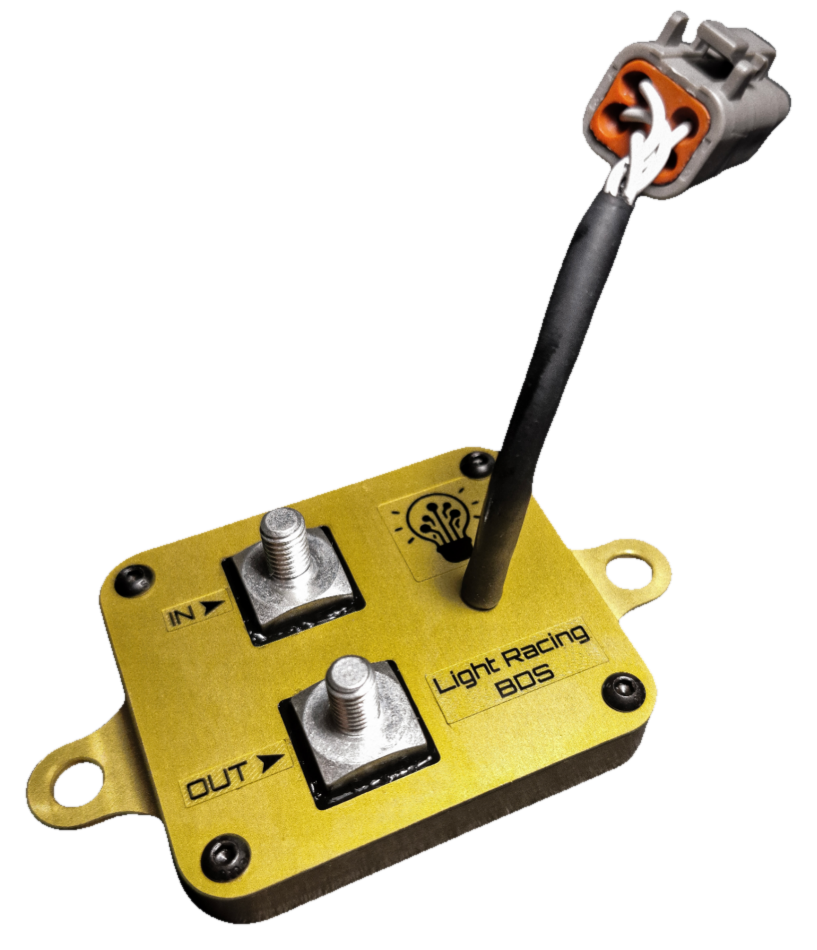
The Light Racing Battery Disconnect Switch (BDS, because everything needs an acronym) is a solid-state switch that replaces the red key entirely. And I mean entirely: the switch, the pull cable, the metres of welding cable to the dash and back, the resistor bodge on the alternator (it has its own 3Ω discharge resistor built in). All of it, gone, replaced by a gold anodised box you could lose in a coat pocket. Instead of copper contacts there's a bank of MOSFETs, the same approach Cartek made respectable in UK club racing years ago. No moving parts, nothing to arc, nothing to pit, nothing to seize.
The headline numbers:
- 800A continuous at 25°C (700A when it's hot), plus a 4,000A rating for microsecond transients. The continuous figure is the one that matters for cranking: a four-cylinder starter pulls a 250 to 600 amp gulp at the moment of crank and then settles well under that. This thing shrugs at an MX5 and wouldn't blink at a V8.
- 70 grams. Less than half the weight of your phone. The switch and cabling it deletes are measured in kilos. I have eaten heavier sandwiches.
- 0.31 milliohms typical internal resistance. At a 300 amp crank that's under a tenth of a volt lost. That knackered MGB switch was dropping five times more.
- IP65 sealed, CNC aluminium case, M6 studs, rated -40°C to 125°C (there's also a 3D-printed ASA version rated to 80°C, but for anything living near heat I'd have the metal one).
- Built-in alternator load dump clamping (it clamps around 16V) plus overvoltage shutdown at 15.5V and undervoltage at 7.1V, so a runaway regulator or a dying battery gets handled automatically.
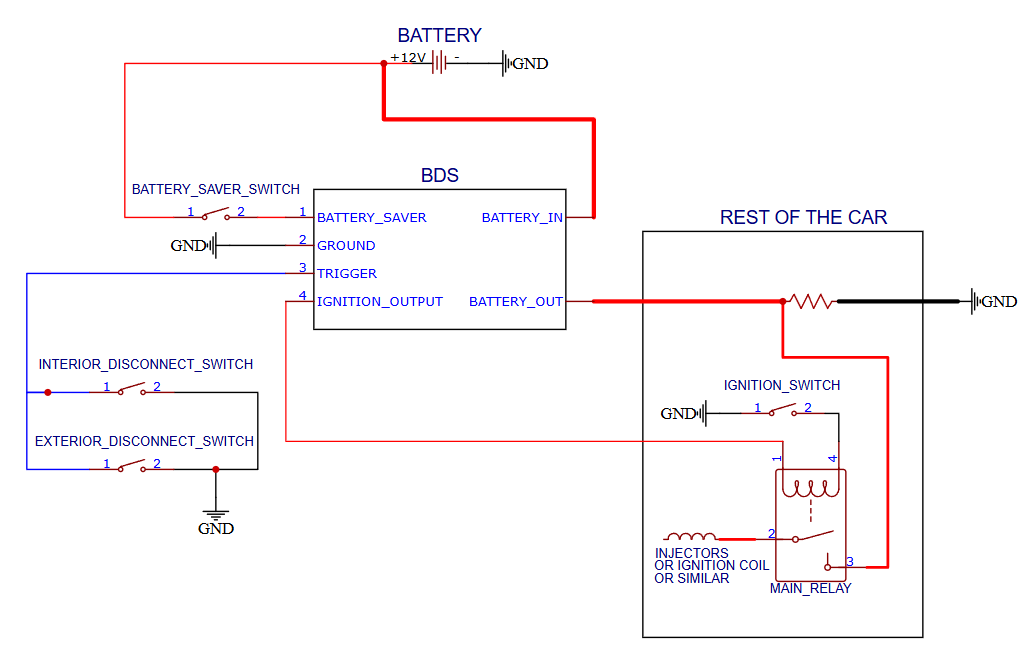
Wiring is refreshingly grown up, and I say that as someone who has spent whole evenings swearing at a 6-pole diagram. Positive cable in, positive cable out, and everything else is four thin wires on a little Deutsch DTM plug: a feed, a ground, a trigger for your kill switches and an output that stops the engine. Have a play:
Because the kill switches are just thin signal wires switching to ground, your dash switch can be a neat latching push button instead of a rotary key the size of a jam jar lid, and the external trigger needs a wire, not a bowden cable.
One detail I properly like: there is deliberately no microcontroller in this thing. The manual lists "No Microcontrollers" like a badge of honour. No firmware, no boot time, no software to crash at the worst possible moment.
The manual also has my favourite line of any document I've read this year. The emergency disconnect procedure: "1) Engage the disconnect trigger switch(es) 2) Run". There's a smiley face after it. In a safety manual. Brilliant.
Built By The Bloke Who Programmed A Hypercar
Light Racing is Nino Križanec, an embedded software engineer from Croatia. His day job is at Rimac, where he developed the powertrain control unit and cooling control unit on the Nevera. The 1,900 horsepower one. When Rimac needed someone to keep nearly two thousand electric horses from misbehaving, he's one of the people they trusted with it. He's certified in ISO 26262, the functional safety standard for automotive electronics, which means "what happens when this fails?" isn't a question he forgot to ask. It's his entire profession.
And here's the bit that made me grin: he got into all this because he bought an MX-5, turbocharged it, and started building electronics for it.
Read that again. A turbo MX5 owner who does hypercar powertrain safety for a living, building better parts for the rest of us on the side. If you engineered a vendor in a lab to appeal to this blog specifically, you'd get roughly that, and I refuse to apologise for how much I enjoy it.
It also explains the design. A firmware engineer who deliberately left the firmware out of a safety device is telling you something.
How It Stacks Up Against The Competition
Solid-state isolators aren't new. Cartek proved the concept to a decade of UK scrutineers and built the category. What's new is getting more switch for less money. Here's how the field actually looks:
Headline current rating vs price
* claimed. Mechanical switches also drag kilos of 50mm² cable to the dash and back; the solid-state units mount at the battery. Prices checked November 2026, all approximate.
A few notes, because comparison charts lie by omission. For a start, every maker rates current their own way (Cartek quotes switching and cranking figures, Light Racing quotes continuous), so treat those bars as each maker's headline number, not a like-for-like lab test.
The Cartek XR is the established name and a genuinely good product. It's also nearly £300 before you've bought the kit, it switches the battery negative (so you're reworking your ground scheme rather than splicing one positive cable), and its 600A rating comes with published engine-size guidance because a big enough starter can trip its overcurrent protection mid-crank. It has LED fault codes, a documented half-second engine-kill delay, and the kits with Cartek's own buttons are genuinely nice. Mature product, mature support, priced like it knows it.
The Light Racing unit matches the XR's weight, carries a 200 amp higher headline rating, switches the positive side like your brain expects, and costs roughly eighty quid less. On paper, the new lad from Croatia just walked into the pub and put the strongest numbers on the table for the least money.
The ECUMaster one is lovely if you're deep into their PMU world (it takes CAN commands, which is properly clever) but you pay for it.
And the £25 mechanical switch is still what most people will buy. It works, until it doesn't, and everything above about arcing, voltage drop, load dump and cable weight applies. The eBay special is the same thing with a mystery metallurgy discount. "FIA type" on a £12 listing describes the shape.
Will A Scrutineer Accept A Solid-State Kill Switch?
Short version: solid-state isolators are everywhere in UK club racing, Cartek built a business on it, and there's nothing in the rules demanding a mechanical device.
Slightly longer version. The FIA requirement (Appendix J, Article 253, art. 13) is functional: the circuit breaker must cut all electrical circuits and stop the engine, must be spark-proof (a requirement solid-state meets better than contacts do, if we're being cheeky about it), and must be operable from inside and outside the car, with the outside trigger at the base of the windscreen marked by the red-spark-in-a-blue-triangle sticker. Motorsport UK's National Competition Rules (the old Blue Book) say much the same: isolate everything except the fire extinguisher circuit, external trigger at the lower windscreen mounting, preferably on the driver's side, sticker visible. They add one rule worth wiring for from day one: resetting the breaker has to be a distinctly different action from triggering it.
One thing worth knowing: the FIA doesn't homologate master switches the way it does seats or harnesses. There is no approval sticker to look for, on any brand. When Light Racing, or Cartek for that matter, describe a unit as FIA compliant, it means the design meets those functional requirements, not that the FIA blessed the unit. That's just how this product category works.
For UK track days, you don't need a kill switch at all. Race series, sprints and hillclimbs generally mandate one. If you run in a specific championship, read your regs (and check the current year's Motorsport UK rules) before wiring anything, because that's true of every part on the car, not just this one.
The Install
This is a much nicer job than wiring a 6-pole rotary. The heavy work is two lugs on one cable; everything else is thin signal wire. Here's how the manual says to do it.
1. Mounting and the main cable
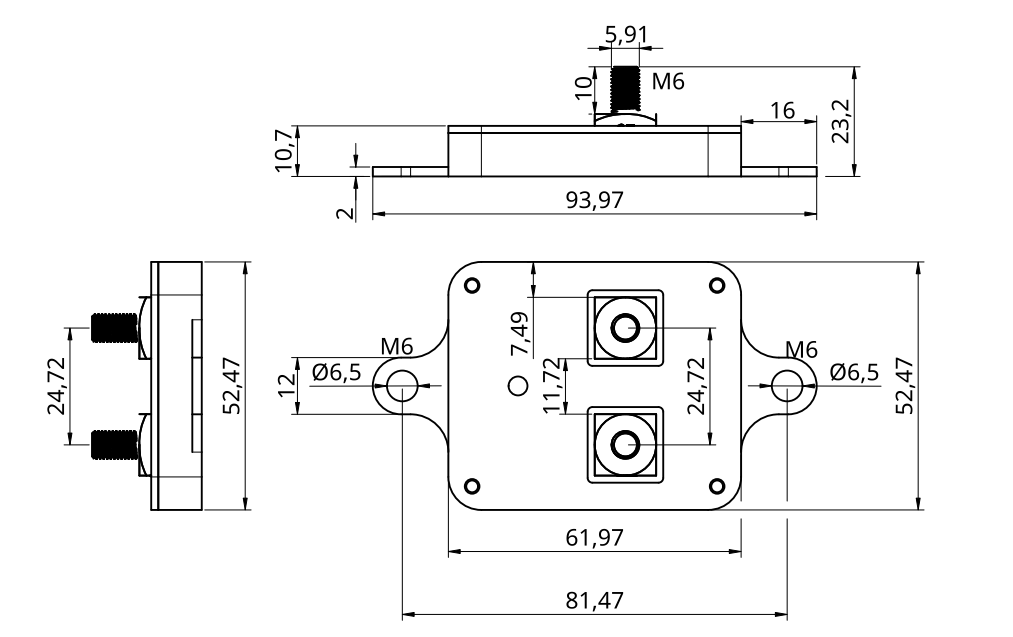
Mount it where the battery positive cable already runs. The manual's preference is inside the cabin, away from heat and fluids, and on rubber bushings if the spot vibrates a lot. M6 bolts or cable ties both work. Cut the positive cable there and crimp an M6 lug on each end. The battery side goes to BATTERY_IN, the car side to BATTERY_OUT. Torque both nuts to 3.9 N·m. That's a 10mm spanner and two fingers, not a gorilla: they're M6 studs in an aluminium case.
2. The 4-pin DTM
Control is a 4-pin Deutsch DTM pigtail on the unit (DTM06-4S), so you'll want the mating DTM04-4P plug. Pins 1 to 3 carry next to nothing, so light 20 to 22 AWG motorsport wire (Spec 44 / Raychem) is plenty there. Pin 4 is the exception: it feeds whatever keeps the engine alive, so size that wire and its fuse for the real load, and remember a standard DTM contact is rated around 7.5A, so use it to run a relay rather than the whole car.
- Pin 1, 12V supply and battery saver: feeds the electronics from the battery side (a lug on BATTERY_IN is fine). Put a hidden toggle in this wire and the BDS draws 0mA in storage instead of about 4mA. Your battery survives winter.
- Pin 2, ground: a clean chassis ground.
- Pin 3, trigger: each kill switch goes between this pin and ground, in parallel, as many as you like. One in the cabin you can reach strapped in, one at the base of the windscreen for the marshal. Latching switches, remember: the car stays dead only while a switch holds pin 3 to ground.
- Pin 4, ignition output: goes to something that stops the engine when it loses power. Light Racing's diagram uses it to power the main relay coil, so the relay drops out the moment the BDS triggers. The manual also lists the injector, coil or fuel pump relay, or your ECU or PDM shutdown input. When the BDS triggers, pin 4 drops, the engine stops, and the clamp deals with the alternator as it winds down.
3. Test-fit a printed dummy first
Light Racing puts a free 1:1 STL on the product page, so you can 3D print a dummy and test-fit it before spending a penny. That's the single most engineer move I've ever seen from a vendor, and I love it. Check bolt spacing, lug clearance and cable bend radius in the spot it's going to live.
4. Test it before you drive it
With every kill switch engaged, reconnect the battery. Then reset the switches one at a time and check BATTERY_OUT only shows battery voltage when all of them are reset. Then check it cranks and charges. Two minutes with a multimeter, and you know it works before a marshal finds out for you.
A Few Things I Love (And One Pro Tip)
You're buying from the engineer. Light Racing is a small, young company (founded 2024) and every unit is made to order. The upside is huge: email support@light-racing.com and you're talking directly to the person who designed the thing, not a ticket queue pretending to have a first name. In 2026 that's practically a luxury feature.
You're early. As far as I can tell, this is the first proper review of the BDS anywhere. No forum threads, no YouTube teardowns yet. Given who built it and what's inside it, I don't think it'll stay a secret for long.
Pro tip for full race cars: wire the crash interlock. The kill switches work by grounding the trigger pin, so it's the switch that kills the car. The manual has a lovely extra trick for proper race cars: route the pin 1 battery-saver feed past the bumpers, doors and fuel cell, so if a big impact breaks that wire, the BDS kills everything on its own. It's one extra wire, and it's the kind of thinking you get from someone who does automotive safety for a living. On a club car with two switches you won't need it; on a race car, I'd wire it.
Should You Buy One?
Get one if:
- You're building or running anything with a standalone ECU, a PDM, a digital dash, or any electronics you'd cry about replacing. The load dump protection alone justifies it over a mechanical switch.
- Your battery lives in the boot and you haven't run the cables yet. The weight and wiring you'll save pays back a decent chunk of what you're spending.
- You want Cartek-class hardware without the Cartek invoice, built by someone who engineers hypercar powertrains for a living. That sold me.
It's probably overkill if:
- Your car is a road car that does the odd track day. You don't need a kill switch at all. Spend the money on brake fluid and instruction.
- You're in a championship whose regs you haven't read yet. Read them first. Some historic classes want period equipment.
The Deal
Made to order and shipped from Croatia within 1 to 10 days. Two versions:
- CNC aluminium, €250 (about £212). The gold one in the photos, rated to 125°C. €225 with LAWRACING10.
- 3D-printed ASA, €200 (about £170). Same electronics, rated to 80°C, fine for a cool spot in the cabin. €180 with LAWRACING10.
Protect Your Build With The Light Racing BDS
Drop up to 3kg of dead cable, cut the voltage drop when cranking, and give your ECU a built-in 16V load-dump clamp. Made by a hypercar powertrain engineer.
The red key had a good seventy-year run. But you've got semiconductors switching your ignition, your fuel and probably your bloody gearbox already. There's no good reason the master switch, the one part whose whole job is working during a crisis, should be the last piece of 1950s copper on the car.
Right, I'm off to press a button and make my entire car stop existing. For safety reasons.
Cheers for reading.